- Industry News
Industry News
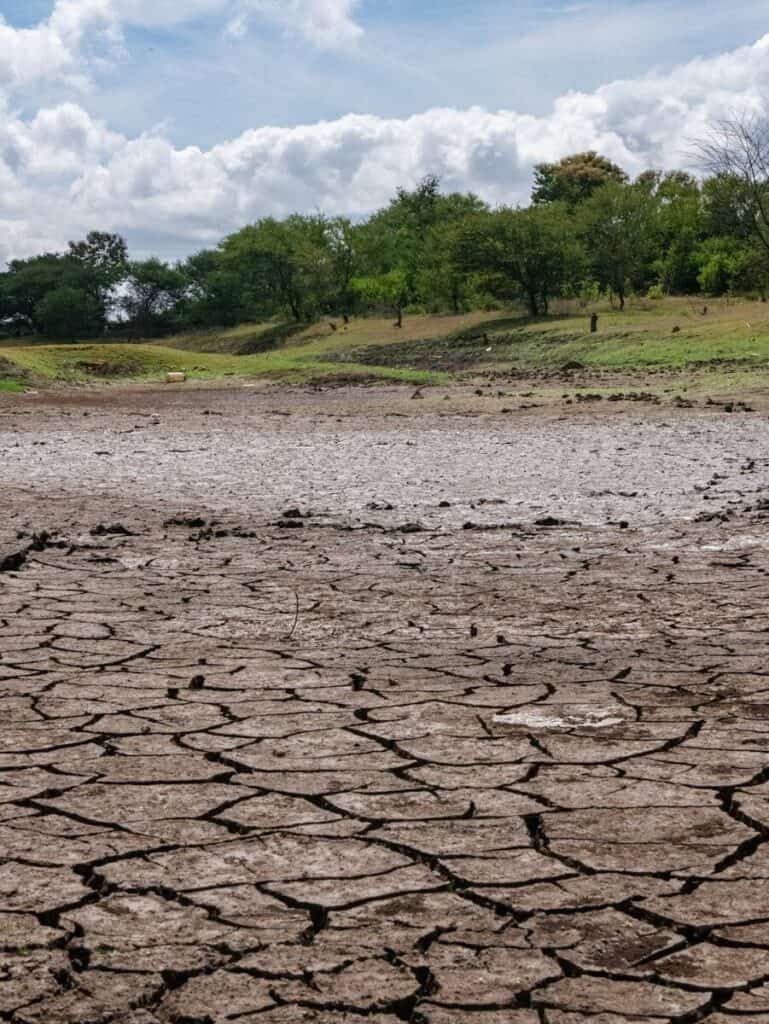
England’s rapidly developing drought is putting water resources under increasing pressure, with 71% of the country by land area in drought by mid-August and more than 27 million people subject to restrictions on their water use.
The headline figures illustrate the scale of the situation. But behind hosepipe bans and falling reservoir levels is a much broader operational response.
Water companies are moving through different stages of their drought plans. The Environment Agency has activated incident-response arrangements. Abstraction restrictions are increasing, drought permits and orders are being considered or sought, environmental monitoring has intensified and operational decisions are being made across individual water resource zones.
Drought preparedness may begin with a plan, but drought resilience is ultimately tested in how effectively that plan can be put into operation.
How quickly have conditions changed?
The speed of the deterioration has been particularly significant.
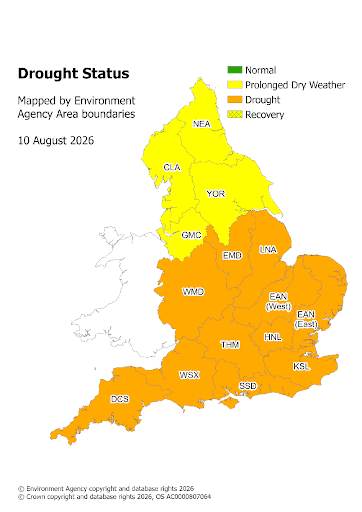
At the end of July, the Environment Agency reported that half of England was experiencing drought following exceptionally dry and hot conditions.
By 13 August, 71% of England by land area was in drought, with the remainder under prolonged dry weather. No Environment Agency areas remained at normal drought status.
Water resources had deteriorated considerably.
Reservoir storage across England had fallen to 65.9% by 11 August — 13.8 percentage points below the long-term average for the time of year. Only 9% of the river-flow monitoring sites included in the Environment Agency’s weekly reporting were recording normal flows, while 28% were classified as exceptionally low.
Eight water companies had implemented temporary use bans across all or parts of their supply areas, affecting more than 27 million people.
This rapid deterioration is why the Environment Agency has described conditions as a “flash drought”: a drought that develops particularly quickly as very low rainfall combines with high temperatures and increased demand.
What happens when a drought plan becomes operational?
Water companies are required to maintain drought plans setting out the actions they may take as water resources come under increasing pressure.
Those plans provide a framework, but the response is not uniform across England — or even necessarily across an individual water company’s operating area.
Companies report their response through operational drought levels, which escalate from drought level 1 through to level 4. Different water resource zones can be operating at different levels depending on local conditions.
By mid-August, for example, some companies remained at drought level 1 in particular areas, while others had progressed to level 2. Temporary use bans were already in place across numerous supply areas.
Southern Water had applied for drought orders relating to the River Test and non-essential water use, while South West Water had applied for a drought permit.
The operational response therefore develops progressively.
Restrictions on customer demand are one part of it, but companies may also need to adjust how existing resources are used, manage abstraction, respond to changing reservoir and river conditions and prepare applications for additional drought measures where necessary.
The Environment Agency expects companies to follow their drought plans and act early to maintain sufficient supplies.
The importance of understanding what is available
During a drought, knowing how much water exists is only part of the operational picture.
Organisations also need to understand what resources and infrastructure are actually available to them at a particular point in time.
The Environment Agency’s August report provides an interesting illustration.
Some reservoirs are currently affected by planned maintenance, safety works or previous planned outages. Elsewhere, reservoir operating rules have changed, while some resources perform additional functions such as supporting river flows or providing flood-storage capacity.
This means a simple measure of reservoir capacity cannot always explain the operational position.
The same principle applies more widely across a water network.
The availability of a source, treatment facility or other piece of infrastructure can be affected by maintenance, asset condition, operational constraints, water quality and other incidents occurring at the same time.
During normal conditions, some of those constraints may be relatively easy to accommodate. During drought, when options are already reduced, their combined effect can become more significant.
Leakage, outages and the resources already available
Before seeking additional abstraction through drought permits and orders, water companies are expected to demonstrate that they are taking appropriate action to manage the resources already available to them.
Environment Agency drought-planning guidance places emphasis on reducing demand, leakage and outage, alongside optimising existing sources and networks.
That makes operational performance particularly important.
Leakage that might already be scheduled for investigation or repair can take on greater significance when water resources are constrained. An unplanned asset outage can remove flexibility from a network at the point when that flexibility is most valuable.
Priorities can therefore change as drought conditions develop.
This is where drought response becomes more than a water-resource planning exercise. It requires organisations to continually assess conditions, risks and operational priorities and translate those decisions into action.
An operational information challenge
Coordinating that response depends on information.
Teams need to understand changing water-resource conditions alongside the operational state of the infrastructure used to manage them.
That can involve information about asset availability and condition, leakage, planned and unplanned outages, water resource zones, environmental constraints, incidents and work already taking place across the network.
Location matters too.
The Environment Agency’s reporting shows considerable variation between areas and individual water resource zones. A company can be managing different drought levels, restrictions and operational pressures simultaneously across its network.
That creates a need to understand not simply what is happening, but where it is happening and which assets, resources, customers and operational teams are affected.
Field activity then creates another layer of information.
Inspections, leakage investigations, repairs, environmental monitoring and other interventions produce new evidence about conditions on the ground. Making that information available to the wider operational picture helps teams reassess priorities as circumstances change.
This is not a specific regulatory requirement or technology prescription. It is a practical consequence of coordinating a complex operational response across assets, geography and changing conditions.
Drought also extends beyond public water supply
The current response demonstrates how interconnected drought management can become.
By mid-August, more than 1,500 abstraction restrictions were in place, including formal restrictions affecting agricultural abstraction in parts of East Anglia.
Environmental incidents associated with drought and dry weather were also increasing, including low flows, algal blooms, fish deaths and deteriorating water quality.
Navigation has been affected too. The Canal & River Trust has activated a national incident response as reservoir-fed waterways experience increasing pressure, with engineering works reducing storage at some reservoirs and restrictions and closures affecting parts of the network.
The Environment Agency itself has activated incident-response arrangements, including gold-command structures, while increasing environmental surveillance and operational interventions.
Drought therefore creates competing demands across public supply, agriculture, the environment and navigation.
Managing those demands requires coordination between water companies, regulators, government, landowners, abstractors and other organisations — often while conditions continue to change.
What does this tell us about resilience?
The effectiveness of drought planning cannot be judged only by the existence of a plan.
The real test comes when organisations need to act on it.
That means recognising triggers early, understanding the condition and availability of resources, changing operational priorities, coordinating activity across different locations and maintaining reliable information as the situation develops.
It also means learning from what happens during the event.
Which assets created constraints? Where was operational flexibility limited? Which interventions proved effective? Did restrictions reduce demand as expected? Were field teams able to respond quickly enough? Where would additional investment or greater resilience make the biggest difference next time?
Those questions connect the immediate drought response with longer-term water resource and infrastructure planning.
From response to future preparedness
England’s 2026 drought is still developing.
The Environment Agency continues to publish weekly updates, water companies remain at different operational drought levels and further permits, orders or restrictions may become necessary if water resources remain under pressure.
The immediate priority is managing that situation safely while protecting public supplies and the environment.
But drought events also provide a real-world test of resilience.
Plans written before an event meet the realities of asset availability, network constraints, environmental conditions and operational capacity. The information gathered during the response can then help shape future drought plans, infrastructure decisions and investment priorities.
That is why operational resilience is about more than responding effectively when resources become scarce.
It is also about using what happens during periods of pressure to understand where resilience needs to be strengthened before the next one.
Further reading: Environment Agency, Dry weather and drought in England: 7 to 13 August 2026; Environment Agency, Drought: how it is managed in England; Environment Agency, Water company drought plan guideline.